

This is kind of a fun and difficult post to write. Fun because it’s that ridiculous, but difficult because it’s tough to anonymize!
First, some math. Let’s say there are 10 people in the room (100%). Because none of the 10 people can be divided into .000001 person, a simple majority of those people is 6. 3 prefer A, 3 prefer B, and 4 prefer C. Neither A, B, nor C has the favor of a simple majority (6). However, because 4 is the largest number in favor of one of the options, everyone gets C. It looks like this:
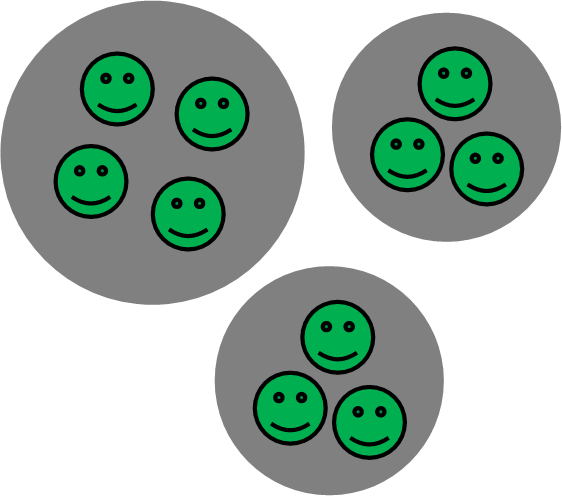
That’s a basic minority rule. If what up to 4 of the 10 people want is what all 10 get because it has the largest number, that isn’t a majority; the minority gets to decide the fate of the majority. If you were in Ohio in 2023, you should have voted regarding a constitutional amendment titled Issue 1, which would change if and how constitutional amendments make it to the ballot.
A conflating consortium (see Know Your Consortium: A Manifesto for a description of that type) will eventually announce which new Integrated Library System it has agreed to purchase. A few combinatorial consortia and cooperative-governing consortia I know have done the same. It’s a big deal for every library and consortium to make this kind of change, as there is usually an exorbitant amount of work involved.
A sales circuit has the same three contenders vying for bragging rights about the institutions and consortia that buy their products. Think of it like a trade show or a library conference: the same companies show up at the exhibit hall every time, no matter where the show or conference is held. Or, like taking your kids to their local youth baseball games: you see the same parents at every game because their kids are on the same team as yours; you often see parents you know whose kids are on other teams because your kids often play against each other–you also know them because you see them at PTA meetings, school dances, morning drop-off, concerts, plays, award nights, etc. Imagine having to pretend no one else knew which parents would be at the game between your kids and their kids. It’s like that. You can’t trademark the word “The” even when there is a legal process to try. And yet, I know from experience that a conflating consortium will eagerly try to earn respect by exerting some sort of litigation, so I’m not even going to name the three out loud. It’s technically an open secret meant to prevent either of the three from being influenced by the competition, but if they were selling in person, they would carpool to the sales pitches, probably have adjoining rooms at the same hotel, and meet for a drink in the hotel bar afterward. And they don’t pretend they don’t know.
There are many thoughts around the field about each product, who buys them, and why. Here’s the anonymized scuttlebutt:
Behind Door Number 1: This is an open-source product. As such, it is eternally under development, both good and bad. It is bad because it may not be ready for some customers that do not have the means to make their own technological improvements. It is good because those who do can make those improvements to directly serve the needs of their libraries and users. It can be both because the community of folks with the wherewithal to create those improvements is eager to share their work with others, so even those without the means can still get the benefit, but when something is needed by one who can’t and isn’t also needed by one who can, the improvement may never come to fruition. The greater good, in this case, can be relative.
Behind Door Number 2: This is provided by a company that is part corporation and part co-op. Most institutions are co-op members, and the product fits relatively seamlessly into existing workflows. But, as the company increasingly faces corporate-think on the inside and capitalist competition on the outside, it has started moving away from the cooperative nature of the field and toward the profit-driven culture of a capitalist society. There are tenets of librarianship that are served by this product, but most importantly, it’s all about cooperation and sharing for the greater good. When a library user from one customer library finds something of interest, they can be confident knowing that if another customer library has the same thing, they will easily find it, too. For example, if your local public library has a book of interest, but you have some free time on vacation in another place, you are likely to find it where you expect it at the public library where you are vacationing.
Behind Door Number 3: The parent company’s parent company was sued by another door because they allegedly* took the content of the plaintiff, claiming it as their own. The folks who have to actually do the bulk of the work with door 3 are widely known to find exorbitant faults and inefficiencies in the system, causing the salaries of library employees to be overspent on dealing with those and underspent on serving library users, though the positions are explicitly intended to serve library users. The folks who have to do the bulk of the work are also widely known to have voted for one of the other products in the selection process yet still end up being forced to work with this one. My conspiracy-theorist tendencies have some interesting thoughts on why, tied to both the lawsuit and the minority rule selections.
The problem is, while door number 1 and door number 2 combined get more votes than door number 3, door number 3 has the highest number alone. And since there isn’t a rule that the choice has to have at least 51% of the votes, minority rule wins out.
In conclusion, I have the privilege by which I can change course altogether. Time to officially dive into that doctorate, maybe make it full-time with some side gigs instead and allow me to focus on writing.
*I say it’s “alleged” because I legally have to…no one won that lawsuit; they just settled.
Disclaimer:
All words and images are my own. If they are not, they are cited as such to give proper attribution to the intellectual property owners.
No words or images reflect the opinions or viewpoints of my current, former, or future employers and educational institutions. They are from my own viewpoint.
 Michelle K. Hahn, MLS, MS PMO